
"washed out"
10000 article(s) found

Brazilian pectin sun-dried coffee beans-the difference between sun-dried and washed coffee beans
Brazilian pectin sun-dried coffee beans-the difference between sun-dried and washed coffee beans is endless in Brazilian coffee fields, most of which are harvested mechanically in order to achieve economic benefits. When 75% of the coffee fruit in the coffee garden turns red, mechanical harvesting is started, followed by the same pre-operation of washing, moving into the sink to remove the floating beans, sifting out the sunken beans, and then using a large pulp screening machine to dig out the pulp and remove the beans covered with pectin.

What are the ways to treat coffee beans? What are the characteristics of honey-treated coffee beans?
Professional coffee knowledge exchange more coffee bean information please follow the coffee workshop (Wechat official account cafe_style) what are the coffee bean treatment methods? What are the characteristics of honey-treated coffee beans? After the planting and harvest of the manor, the following is the most important step in addition to the variety and planting land: the "post-treatment method". At present, most of the treatments are treated in the sun.

Coffee raw bean treatment classification, different treatment of coffee is not very different?
For information, please pay attention to the coffee workshop (Wechat official account cafe_style) after the coffee fruit is ripe and picked from the tree, it will be processed into dried coffee beans, so there are basically three drying methods / sun drying method / natural treatment method (Dry process----natural method) wet treatment method / water washing method (Wet process----washe).

What does it mean to wash tea and wake up tea? how long does it take to wake up tea?
From childhood to childhood, every time I drink tea with my parents, in addition to Guangdong's unique hot washing utensils with boiling water, there is also an action that I still can't understand: rinse the tea, that is, pour the first tea! Yes, that's right! It's down! Of course, every time will ask the elders, why pour out, those are also the essence of tea, ah, pour out is not a bit of a waste

Different processing methods of raw coffee beans and their respective advantages and disadvantages
Coffee treatment: refers to the removal of coffee cherry exocarp, pulp, mucous membrane, endocarp, silver skin five parts. There are water washing method WIB, sun method OIB, half water washing method (Semi washed method), half sun method (also known as honey treatment Miel Process) sunlight method because of the use of natural sunlight to dry the fruits and raw beans of coffee, so it is also called nature

Flannel hand-made coffee-unforgettable warm taste and amber transparent color
Professional coffee knowledge exchange more coffee bean information please follow the coffee workshop (Wechat official account cafe_style) "how do first-class baristas drink coffee at home" flannel filter coffee Nel drip flannel hand brewed coffee-unforgettable warm taste and amber transparent color. Hand brewing should be a shortcut to a good cup of coffee at home. The cost of equipment is not high, simple

The most complete coffee beans are picked from trees to roasted and matured, washed, sunburned in Brazil, etc.
After the planting and harvest of the manor, the next step is the most important step in addition to the variety and planting land: "post-harvest treatment". At present, most of the treatment methods are mainly sun exposure, semi-washing and water washing, and there are also several special treatment methods: honey treatment, in vivo treatment, and so on. Many people are sharing these treatments on the Internet, no matter how I write them.
An introduction to the basic concept of raw beans
Douxiao doesn't look good. Grading: the seeds are taken out and then screened and graded. Guatemala, Costa Rica and other countries are rated according to the planting height, more than 4500 feet above sea level is the highest "extremely hard bean" (SHB). Colombia, Kenya and New Guinea are graded by particle size, with larger and higher grades (with the exception of Kenyan beans). In addition, there are some producing countries in accordance with the defects.

How to flush out the flavor of scented tea and share it with Yega Chuefei.
Professional coffee knowledge exchange more coffee bean information please follow the coffee workshop (Wechat official account cafe_style) Qianjie Coffee-washed Yega Chuefei brewing sharing Yejia Chuefei is synonymous with fruity and floral coffee, clean and bright taste and lively acidity unforgettable. Yega Xuefei is an excellent producing area with many legends, and it is also one of the boutique coffee markets in the past decade.

Water-washed sun-cured coffee beans explain in detail the difference in the taste of water-washed sun-cured coffee beans
Professional coffee knowledge exchange more coffee bean information please follow the coffee workshop (Wechat official account cafe_style) when drinking coffee usually look at the labels of the merchants will always say what sun, water washing, honey treatment and other treatment methods, sun, water washing is also relatively easy to understand, but what honey treatment, wet planing, really do not understand what the ghost is, so the editor now

How should raw bean coffee be handled? how should raw bean coffee be stored?
Water washing (washing, washing out a clean sour taste) in the mid-18th century, the Dutch invented water washing treatment, which was widely favored. The methods are as follows: 1. Harvest coffee fruit. 2. Throw the fruit into the pool and eliminate the floating ones. 3. Throw the sunken fruit into the machine and beat off the skin and flesh. 4. Throw it into the sink and ferment for 16-36 hours to remove pectin. 5. Wash and dry.

Introduction to the basic knowledge of raw beans in boutique coffee
Douxiao doesn't look good. Grading: the seeds are taken out and then screened and graded. Guatemala, Costa Rica and other countries are rated according to the planting height, more than 4500 feet above sea level is the highest "extremely hard bean" (SHB). Colombia, Kenya and New Guinea are graded by particle size, with larger and higher grades (with the exception of Kenyan beans). In addition, there are some producing countries in accordance with the defects.

How to deal with coffee beans? how to handle coffee? how to deal with high-quality coffee?
After taking out the sticky pods of the red fruit, move them into a large sink, followed by the most important washing and fermentation to remove pectin shavings from the pods. This sticky material is not easy to wash away with water, so it is necessary to hydrolyze the pectin with all kinds of bacteria in the tank, decompose the pectin and wash the pods in the tank to accelerate the pectin to break away from the pods. The fermentation process takes about 16 to 36 hours.

Introduction to the basic concept of raw beans small beans are not good.
Douxiao doesn't look good. Grading: the seeds are taken out and then screened and graded. Guatemala, Costa Rica and other countries are rated according to the planting height, more than 4500 feet above sea level is the highest "extremely hard bean" (SHB). Colombia, Kenya and New Guinea are graded by particle size, with larger and higher grades (with the exception of Kenyan beans). In addition, there are some producing countries in accordance with the defects.
The sun? Washing? Lure out the sweet and sour processing.
The processing of coffee cherries has an important influence on the final coffee flavor. Even the same coffee cherries will have different processing procedures, showing a completely different aroma and taste in the end. Not only that, in case there is something wrong with the processing process, it may also make the coffee flavor have a fatal defect, resulting in the whole batch of damaged beans reimbursed. Characteristics of their respective processing methods

What are the ways to treat raw coffee beans? What are the advantages and disadvantages of coffee beans treated with sun water and honey?
What are the ways to treat raw coffee beans? What are the advantages and disadvantages? All kinds of raw bean treatment methods, we must first know the structure of coffee fruit, cherry-like coffee fruit, from the outside to the inside are peel, pulp, pectin layer, sheep skin (seed shell), silver skin, seed. The thickness of pectin layer is about 1-2mm, which can be thought of as tomato.

Does the sourness of washed beans come from fermentation?
The sour taste of washed beans comes from fermentation. Fine farms will identify defective beans manually or by machine and pick them out and throw them away. The manual selection method usually uses a conveyor belt about 1 meter wide, with several female workers sitting on both sides to visually select the bad beans; some good farms even go through several selections until no defective beans are found. machine selection rule

Coffee bean processing Mechanical semi-washing of coffee beans
Not all producing areas can be used Brazil semi-sun method, moisture heavy producing area Nuo take out sticky pectin pods, and then get outdoor exposure, not only difficult to dry hard, but easy to parasitize mold, so the heavy moisture area developed mechanical semi-washing method, both save trouble and save water. First, the red fruits and half-green and half-red fruits that have sunk into the sink are moved into the pulp sifter and taken out of the sticky fruit

What are the raw coffee beans like? What is the way to handle it? What's the difference in the treatment of various raw beans?
Professional coffee knowledge exchange more information about coffee beans Please follow the coffee workshop (Wechat official account cafe_style) what are the raw coffee beans? What is the way to handle it? What is the difference in the treatment of various raw beans? In order to talk about all kinds of raw bean treatment, we must first know the structure of coffee fruit, cherry-like coffee fruit, from outside to inside are peel, pulp, pectin layer, sheep skin (seed).
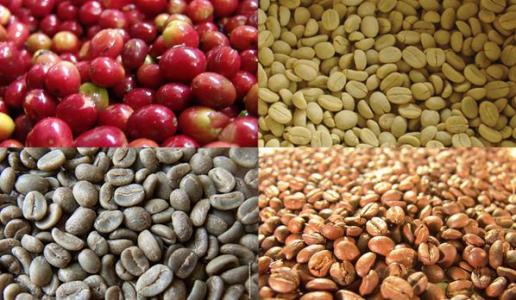
Flavor characteristics of Brazilian coffee beans in Brazilian half-sun treatment story of Brazilian coffee beans
Description of flavor acidity of sun treatment and Brazilian half-sun A brief introduction to the acidity of coffee fields in Brazil, most of them are harvested mechanically in order to achieve economic benefits. When 75% of the coffee fruit in the coffee garden turns red, it starts to be harvested mechanically, followed by the same pre-operation of washing, moving into the sink to remove the floating beans, sifting out the sunken beans, and then using a large pulp screening machine to dig out the pulp and take it out.